
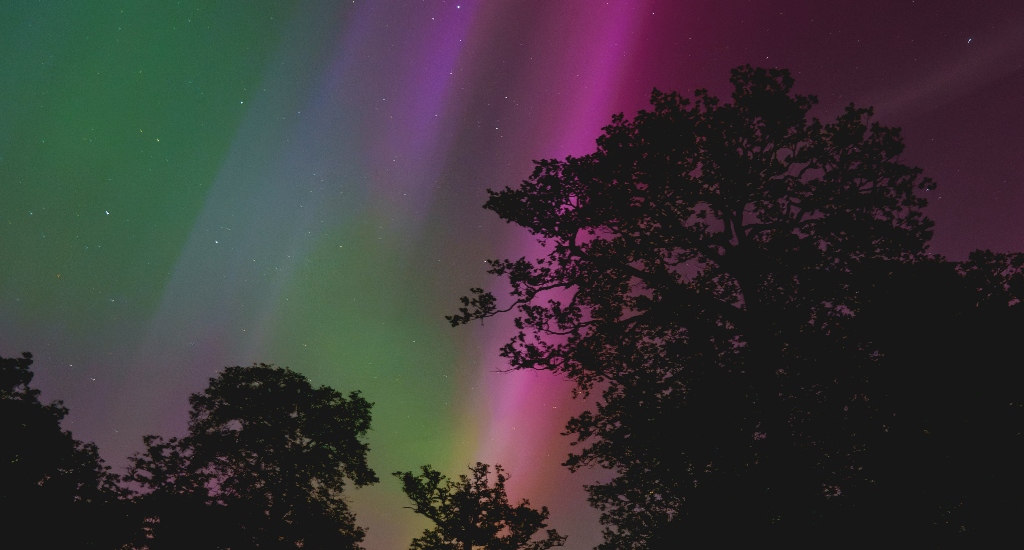
The Northern Lights are appearing further south than ever before. In May 2024, the most extreme geomagnetic storm in two decades made them visible as far south as Cornwall.
What’s more, 2025 is expected to be one of the best aurora seasons again according to research, as the current solar maximum, when the sun is most active, continues for a few more years before waning in its eleven-year cycle.
This surge in visibility has sparked massive interest – searches for “Met Office Northern Lights alert” have increased by 5,000% in the UK over the last year and “Aurora Borealis UK” by 150% over the same period.
And rather than having to travel to traditional aurora destinations, Brits can now spot them much closer to home.
Some of the very best places in the UK to view the phenomenon are our National Parks. Given their minimal light pollution and remote locations, these offer prime viewing conditions that will maximise chances of spotting the Aurora Borealis.
But when and where are you most likely to see them?
Well, our Northern Lights Calculator shows you exactly that. Our team has analysed 30 years of geomagnetic data to highlight the optimal dates and locations across the UK’s 15 national parks to see the phenomenon.
Northern Lights Calculator
The Best Days of the Year to See The Northern Lights
Our analysis reveals that 7th November is the best day of the year to be in with a chance of spotting the Northern Lights dance across the UK’s national parks.
On this date, there has been Northern Lights activity across all 15 national parks during the last three decades, giving it an average likelihood of 25.56% witnessing its appearance.
It may be unsurprising that this date took the top spot, given that it’s on the cusp of winter when daylight hours are fewer!
22nd October emerges as the second-best annual date, also showing widespread Northern Lights activity across multiple parks throughout the country, with a 23.78% average likelihood.
So long as you have ideal conditions for spotting the lights, it’s worth looking up at the sky on this date!

When Can You See The Northern Lights In The UK?
Seeing the Northern Lights in the UK requires far more than just high geomagnetic activity – it’s all about timing and luck with the weather.
The Northern Lights in the UK are heavily seasonal, with your best viewing window stretching from September through March when nights are properly dark. For example, while our data highlights promising aurora potential on dates like 7th July, you’d very likely be out of luck trying to spot anything during Britain’s bright summer nights when darkness barely arrives.
But even during prime season, you’re also completely dependent on clear skies – and we all know how unpredictable British weather can be. You could have the most promising geomagnetic forecast, but thick cloud cover will totally ruin any chance of spotting the aurora!
Location also matters enormously, so you’ll need to avoid light pollution as much as possible by going to remote areas like National Parks or Dark Sky Sites. The moon adds another variable as well; a little moonlight can help you navigate, but too much will wash out the fainter aurora displays.
This is why our percentage likelihoods represent geomagnetic activity potential rather than guaranteed sightings.
Successfully catching the Northern Lights in the UK requires combining our data-driven predictions with real-time weather monitoring, choosing the right dark sky location and, honestly, quite a bit of patience.
Even with perfect planning, Mother Nature has the final say on whether you’ll witness this incredible phenomenon!
The Best UK National Parks To See The Northern Lights
#1 Cairngorms National Park – 23.41% average daily likelihood
- Peak likelihood: 53.33% (4th September)
- Scotland’s largest National Park leads the rankings with nearly a one-in-four chance of aurora activity on any given date
- The Glenlivet Estate offers dark sky status with minimal light pollution
- Perfect viewing spots include Scalan in the Braes of Glenlivet
#1 Loch Lomond & The Trossachs National Park – 23.41% average daily likelihood
- Peak likelihood: 53.33% (4th September)
- Tied for first place, Scotland’s first national park also offers excellent viewing conditions with almost a 25% chance on any day of the year
- The eastern shores of Loch Lomond are renowned for aurora viewing locations
- Rugged hills and remote landscapes to maximise visibility
#3 Northumberland National Park – 10.3% average daily likelihood
- Peak likelihood: 36.67% (2nd May and 7th November)
- England’s best park for Northern Lights, with the country’s cleanest air and darkest skies
- Stonehaugh village is a dedicated Dark Sky Discovery Site
- Rolling hills provide unobstructed views of the northern horizon
The Best Day of the Year For Seeing The Northern Lights In Each UK National Park
For those across the country who are fortunate enough to have beautiful British wilderness right on their doorstep (or for those who are yearning for a trip to discover it at their next available opportunity!), you may be wondering when the best day to see the Northern Lights is for each of the country’s 15 national parks.
Well, we’ve got the results…
Brecon Beacons (Bannau Brycheiniog): 22th October & 7th November
The highest likelihood of seeing the Northern Lights in the Brecon Beacons National Park is 26.67%, and two dates in the year offer this degree of likelihood with dark enough skies: October 22nd and November 7th.

The Cairngorms: 4th September
To spot the Northern Lights in Scotland’s beloved Cairngorms National Park, the end of the summer season holds the winning date of the year, with a 53.33% likelihood of seeing them on 4th September.
Dartmoor: 7th, 8th, 17th and 25th September, 2nd and 22nd October, and 7th and 8th November
One of Britain’s first national parks, Dartmoor has multiple dates throughout the year which have been shown to offer some of the highest chances of seeing the Northern Lights. Those in months dark enough to see are 7th, 8th, 17th and 25th September, 2nd and 22nd October, and 7th and 8th November, all of which have a 13.33% likelihood of spotting them.

Exmoor: 7th, 8th, 17th and 25th September, 2nd and 22nd October, and 7th and 8th November
Home to the highest coastline in the British mainland, the south of England’s Exmoor National Park shares the same best dates to see the Northern Lights as its nearby neighbour national park of Dartmoor, with an equal 13.33% likelihood of spotting the phenomenon on any of these dates: 7th, 8th, 17th and 25th September, 2nd and 22nd October, and 7th and 8th November.

Lake District: 22th October & 7th November
The UK’s second-largest national park, the Lake District National Park, has the highest chances of seeing the Northern Lights on three dates – October 22nd and November 7th – all of which have a good 26.67% likelihood of sightings.

Loch Lomond & The Trossachs: 4th September
The fourth largest national park in the British Isles, Loch Lomond and the Trossachs, shares the same best date to spot the Northern Lights as its sister Scottish national park, the Cairngorms. 4th September shows a promising 53.33% likelihood of sighting them, according to our analysis.

New Forest: 7th, 8th, 17th and 25th September, 2nd and 22nd October, and 7th and 8th November
The beautiful New Forest National Park also shares the same best dates to sight the Northern Lights as Exmoor and Dartmoor National Parks, and the same percentage likelihood of spotting them too! The 7th, 8th, 17th and 25th September, 2nd and 22nd October, and 7th and 8th November all share a 13.33% likelihood of seeing the phenomenon in England’s sky, being months when the skies get dark enough to see it.

Norfolk Broads: 7th, 8th, 17th and 25th September, 2nd and 22nd October, and 7th and 8th November
To be in with a chance of seeing the Northern Lights in the Norfolk Broads, Britain’s largest protected wetland, your best bets are looking up to the skies on 7th, 8th, 17th and 25th September, 2nd and 22nd October, and 7th and 8th November. All of which have a 13.33% likelihood of spotting the phenomenon.

North York Moors: 22th October & 7th November
Situated in the beautiful North Yorkshire countryside, North York Moors National Park has the highest likelihood of seeing the Northern Lights on the 16th July, October 22nd and November 7th, coming in at 26.67%.

Northumberland: 2nd May & 7th November
England’s northernmost national park, Northumberland National Park, has two dates that tie as having the highest likelihood (36.67%) of seeing the Northern Lights, these being: 2nd May and 7th November.

Peak District: 22th October & 7th November
England’s much-loved Peak District National Park has two dates that have the highest likelihood – coming in at 26.67% – of spotting the natural phenomenon with dark enough skies to views: October 22nd and November 7th.

Pembrokeshire Coast: 22th October & 7th November
One of the UK’s smallest national parks – the Pembrokeshire Coast National Park – has October 22nd and November 7th as its top dates for seeing the Northern Lights, with a 26.67% likelihood of catching a glimpse of them on one of these dates.

Snowdonia: 22th October & 7th November
Wales’ largest national park, Snowdonia, has three dates that show the highest likelihood (26.67%) of spotting the Northern Lights in the Welsh night sky, which are October 22nd and November 7th.

South Downs: 7th, 8th, 17th and 25th September, 2nd and 22nd October, and 7th and 8th November
The South Downs National Park is the UK’s most populous national park, and it has several dates throughout the year that offer the highest likelihood (6.67%) of seeing the Northern Lights. Those in the months that would be dark enough to see the Northern Lights include four dates in September (7th, 8th, 17th and 25th), two dates in October (2nd and 22nd), and two November dates (7th and 8th).

Yorkshire Dales: 22th October & 7th November
The wild Yorkshire Dales National Park has two top dates for potentially sighting the Northern Lights with dark enough skies – October 22nd and November 7th – with both having a 26.67% likelihood of catching a glimpse of the phenomenon.

Methodology
We extracted publicly available geomagnetic data, specifically KP readings, from the past 30 years to calculate the percentage likelihood of seeing the Northern Lights on any day of the year in any of the UK’s national parks.
The UK’s national parks were assigned a KP value obtained from a credible source.
Multiple KP readings for each day of the year were taken into consideration.
Any dates in the summer season were discounted from the final stage of analysis due to optimal conditions for seeing the Northern Lights being smaller in this season.
This data is an estimation based on the KP data obtained only and doesn’t take into account other factors that play a role in determining how likely people are to view the Northern Lights, including cloud coverage.