
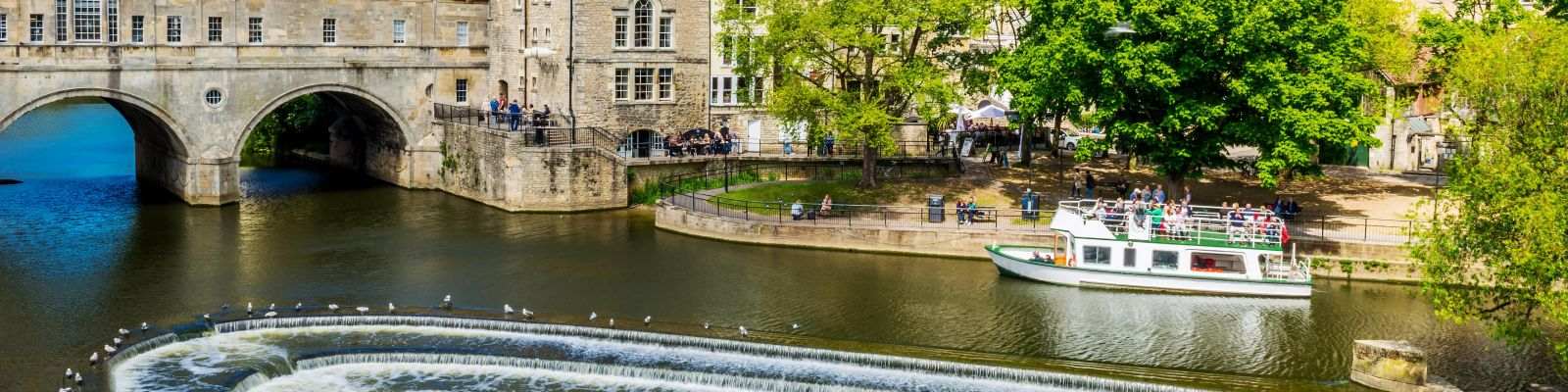

Bath
The City of Bath, a UNESCO World Heritage Site, is well known for its Roman origins and Georgian architecture. The Roman Baths are one of the best-preserved Roman remains in the world, the centre piece being the Great Bath, a huge lead-lined pool filled with steaming, natural spring water. Next door to the Baths, the 16th Century Bath Abbey, features massive stain glass windows and Victorian Gothic interiors. After climbing the 212 steps of the Abbey’s Tower you will be rewarded with 360 degree panoramic city views. For a walking tour of the Georgian architecture head to the infamous Royal Crescent which overlooks the Royal Victoria Park. Designed by John Wood the Younger between 1767 and 1774, it is a fantastic example of Georgian architecture. Literary buffs will be keen to explore the Jane Austen Centre where you can discover more about Jane Austen’s life in Bath through immersive tours and interactive exhibits including trying on Regency-style gowns and writing with a quill and ink.
Wells
There is much more to Wells than its claim as the smallest City in England. The blend of medieval architecture and historic landmarks with independent shopping all within a small walkable area makes it a great city to visit at any time of the year. The 12th Century Gothic inspired Wells Cathedral is often described as an architectural masterpiece with its incredible iconic scissor arches, stunning West Front and an astronomical clock. Daily tours run including visiting the 15th-century library as well as the ‘High Parts Tour’ which includes the inner workings of the famous clock. The Bishop’s Palace and Gardens was home to the Bishops of Bath and Wells for over 800 years. The medieval palace is set in 14 acres of RHS partner gardens. Wells is also home to Vicar’s Close, the oldest purely residential street in Europe. Originally built for Bishop Ralph of Shrewsbury in 1348 to house the Vicars Choral, the buildings are still residential homes today.
Glastonbury
The town of Glastonbury is perhaps most well-known for its alternative vibe and huge annual festival at Worthy Farm. However, it also has a deep-rooted history and spiritual connections and today remains a major centre for pilgrimages. The mystical Glastonbury Abbey, linked to the legend of King Arthur and once one of the most powerful and wealthy monasteries in the country, is still a spiritual focal point for many. Or visit the iconic Glastonbury Tor, a 521 foot conical hill with the 15th Century St Michaels Tower at the top. The National Trust site is not only a fantastic spot to enjoy the panoramic views of the Somerset countryside but also has a deep spiritual significance and is famous for its association with Arthurian legends.
Dunster Castle
Dunster Castle and Watermill is a historic motte-and-bailey castle located in the medieval village of Dunster within the Exmoor National Park. Now managed by the National Trust, the castle has evolved from a Norman fortress into a stunning Victorian family home set within 15 acres of subtropical gardens and a working watermill. Inside the castle the highlights include the grand staircase, rare 17th Century leather hangings and the eerie Crypt. Perched on top of a Tor the castle offers panoramic views of Exmoor National Park, the rolling Quantock Hills and even the South Wales coast across the Bristol Channel. When you are done with exploring the castle head back down to Dunster village where you can admire the historic buildings before heading to one of the many cafes for an afternoon tea.


